

Definition, Function, Examples, and Importance in Biotechnology & Medicine
Table of Contents
- What Is a Signal Peptide?
- Why Signal Peptides Matter (In Simple Terms)
- How Signal Peptides Work: Step-by-Step
- Signal Peptide Structure (N-region, H-region, C-region)
- Examples of Signal Peptides in Real Proteins
- Signal Peptides vs Transit Peptides vs Signal Sequences
- Signal Peptide Prediction Tools (Bioinformatics)
- Signal Peptides in Biotechnology and Drug Development
- Disorders Related to Signal Peptide Malfunctions
- FAQs About Signal Peptides
1. What Is a Signal Peptide?
A signal peptide (also called a signal sequence or leader peptide) is a short stretch of amino acids (usually 15–30 residues) found at the beginning of a newly made protein.
Purpose:
It acts like a postal address — telling the cell where to send the protein (e.g., outside the cell, into the ER, or a specific organelle).
2. Why Signal Peptides Matter (Simple Explanation)
Imagine your cell is a giant factory. Every time a protein is made, it needs to go to the right department (membrane, lysosome, outside the cell, etc.).
Signal peptides are like zip codes attached to the protein — they tell the cell,
🧭 “Ship this protein to the membrane,” or
📦 “Export this out of the cell.”
Without signal peptides, your body would be a chaotic mess of misdelivered proteins.
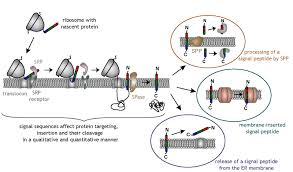
3. How Signal Peptides Work: Step-by-Step
- Protein Synthesis Starts at the ribosome (translation)
- If the protein has a signal peptide at its N-terminus, the ribosome pauses
- The Signal Recognition Particle (SRP) binds the signal peptide
- The whole complex moves to the endoplasmic reticulum (ER)
- The protein is threaded into the ER lumen
- The signal peptide is cleaved off by a peptidase
- The mature protein continues to fold and move to its final location
4. Signal Peptide Structure
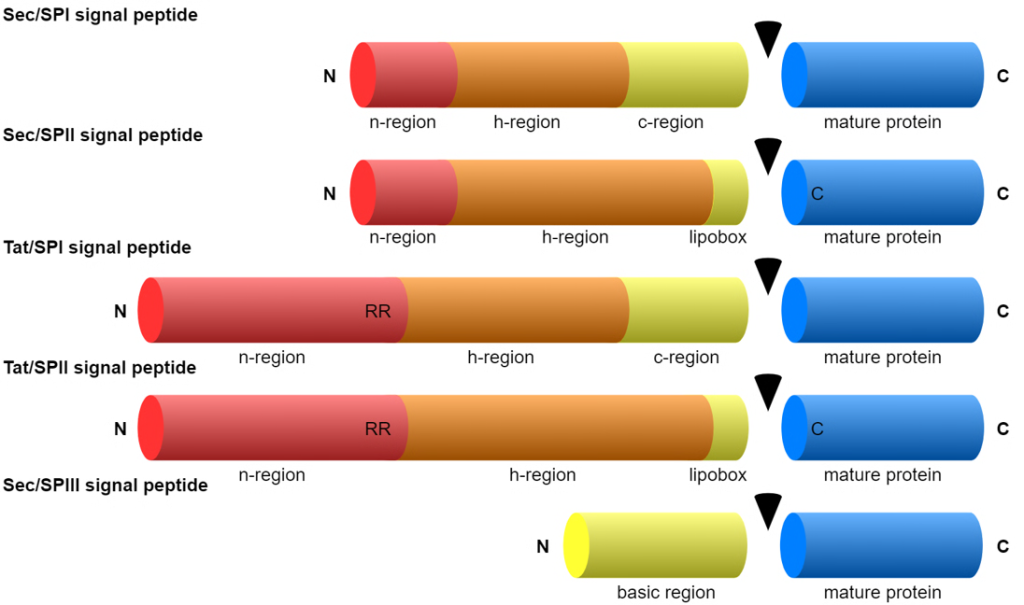
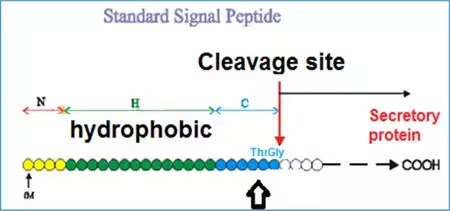
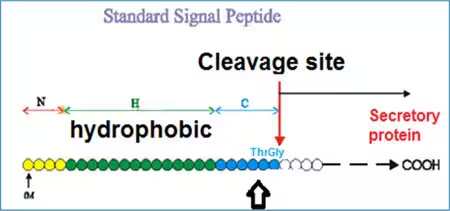
Signal peptides generally have 3 regions:
| Region | Function | Amino Acid Traits |
|---|---|---|
| N-region | Positively charged | Arginine (R), Lysine (K) |
| H-region | Hydrophobic core | Leucine (L), Isoleucine (I), Valine (V) |
| C-region | Cleavage site | Small, neutral amino acids (Ala, Gly, Ser) |
Example sequence:
M-K-L-L-V-P-L-L-L-L-A-A-A-Q-A-A-A-D-A-E-A
(Methionine starts translation, followed by hydrophobic region, then cleavage site)
5. Examples of Signal Peptides in Real Proteins
| Protein | Signal Peptide Present? | Destination |
|---|---|---|
| Insulin | ✅ Yes | Secreted into bloodstream |
| Antibodies | ✅ Yes | Exported from immune cells |
| Lysosomal enzymes | ✅ Yes | Delivered to lysosomes |
| Hemoglobin | ❌ No | Stays in cytosol (no signal peptide) |
6. Signal Peptides vs Other Targeting Sequences
| Type | Function | Location |
|---|---|---|
| Signal Peptide | ER targeting & secretion | N-terminus |
| Transit Peptide | Mitochondria/chloroplast | N-terminus |
| Nuclear Localization Signal (NLS) | Targets nucleus | Internal |
| Peroxisomal Targeting Signal (PTS) | Targets peroxisomes | C-terminus |
Signal peptides are only for entry into the secretory pathway (ER).
7. Signal Peptide Prediction Tools
Bioinformatics can predict whether a protein has a signal peptide:
- SignalP (most widely used)
- Phobius
- DeepSig
- TargetP
These tools analyze amino acid sequences to detect signal peptide motifs and cleavage sites.
8. Signal Peptides in Biotechnology and Drug Development
Signal peptides are used in biotech to:
✅ Design recombinant proteins for secretion (e.g. insulin production in yeast)
✅ Engineer antibody drugs for efficient expression
✅ Control protein localization in gene therapy vectors
✅ Improve yield in protein manufacturing systems
In gene editing (CRISPR, AAV vectors), adding a custom signal peptide ensures the protein ends up where it’s needed.
9. Disorders Linked to Signal Peptide Malfunctions
Mutations in signal peptides can lead to:
- Signal Peptide Deficiency → Proteins misfold or accumulate
- Chronic Granulomatous Disease (CGD) → From a faulty signal in the CYBB gene
- Hypothyroidism → From altered thyroglobulin signal peptide
- Cystic fibrosis-like conditions (in rare variants)
These defects often cause proteins to fail to reach their destination, resulting in disease.
10. FAQs About Signal Peptides
Q: Are signal peptides always removed?
A: Yes — after targeting is complete, the peptide is usually cleaved by signal peptidase in the ER.
Q: Can proteins have more than one signal?
A: Yes — some proteins have multiple targeting signals (e.g. ER + Golgi signals) for stepwise transport.
Q: Do bacteria use signal peptides too?
A: Absolutely. Prokaryotes have signal peptides for exporting proteins through Sec or Tat pathways.
Q: Can I add a signal peptide to my gene construct?
A: Yes — synthetic biology often uses optimized signal peptides to enhance protein secretion.